You may find names that end in -son which often means “the son of”.
So Thor, the Norse god of thunder, his last name is Odinson, making him the son of Odin.
Odin’s last name could be Borson, which means Odin was the son of Bor,
-and Bor was the son of Buri, so it would be Bor Burison.
Peterson means they are the son of Peter, and we can see this in other names,
Here are some other names, not a complete list of names, that end in son:
Morrison
Gibson
Carson
Johnson
Davidson
Haroldson
Harrison
Patterson
Robertson
Jackson
Jefferson
Edison
Larsson
This is a link to a page of a website with surnames ending in -son:
https://surnames.behindthename.com/names/tag/ends_in_-son
In Danish fashion the last names might end in -sen which translates to ‘son of’. Here is a short list of examples;
Jansen
Hansen
Andersen
Larsen
Jorgensen
Madsen
Olsen
You know how some people add numerals to annotate the lineage and difference between Henry and Henry the third. One can instead just add Son to the name instead of a number. This custom of surnames being given to a person using the father’s name with ‘son’ on it seems to be rooted from either Old English and Scandinavian heritage. If the child was a daughter, in Scandinavian, then the last name would end with the suffix -dóttir.
Here is a related query where someone provides similar insight:
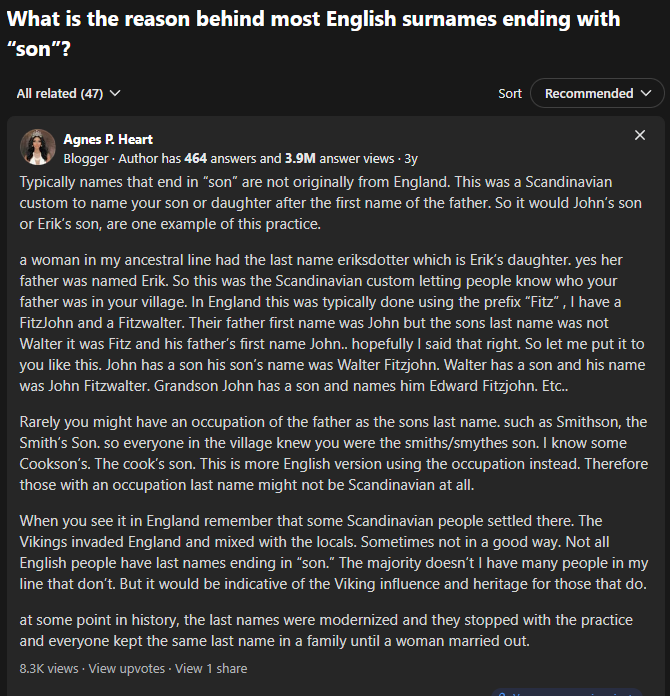
Since the custom of Western society is to adopt the names from the father or patronymical side, it makes sense that we see more last names ending in -son rather than -dotter. Often times the maiden name or matronym or the mother’s last name isn’t carried forward in contemporary traditions. Which helps explain why we see more last names ending in -son than -dottir.
Which kind of makes it funny and connfusing if you happen to have someone time travel into the future and they see women with the last names ending in -son.
Here is a link of some surnames ending with -dottir:
https://worldnames.xyz/surnames-ending-with-dottir/
And further insight, Scandinavian ‘last names’ aren’t last names like we use in today’s society. They were more secondary names that borrowed from their family heritage to help identify people. In modern times, last names are more static whereas secondary names are just another name to add to who you are. Kind of like titles as identifiers, but not quite.
They’re called patronymic second names. Patro- meaning Father parent or loosely related paternally, and suffix -nym relating to or meaning ‘name’. As opposed to matronym, matro- for relating to the mother or matriarch.
So if there was a David who was the son of Erik, he’d be David Erikson, and if David had a son named Jack, Jack would be Jack Davidson. The last names were more second names to point to something more relative and known for the people at the time.
Last names being static, were reserved for professions and nobility that have heritable names that were kept the same throughout the bloodline. It sort of pointed to a honorable ancestor that achieved great feats and such, and as such were carried with pride, prestige, and honor while also serving utility to help in clarifying the blood ties and relations.
In modern times, it’s easier for government and census tracking reasons as well as for larger societies to see a person tied to a fix last name. Because being the son of David is only useful to those who know who David is (as well as if you know ‘which’ David is being referred to), as society gets larger and there becomes more people and names, it sort of pushed us into using a more permanent or static last name for stronger reference value. Nowadays if you see someone sharing the same last name, you’d think or assume there’d be a blood relation at some point, even faint (although there are adoptions, name changes, and other factors that can make it so there’s no blood relation).
Arguably the invention of second names, last names, and titles were to help differentiate people who shared the same name. It’d be very confusing to talk to two people with the same names without something to differentiate them let alone in the same village especially when rumors go about and around. Often times people might say their full name and say something along the lines of ‘no relation’ or ‘not related to —-‘ and someone else’s more recognized name.
There’s a funny story I’ve heard of some US marines with two Juan Hernandez’ in the same squad. As such they called one of their Juan’s as “John” to make a difference. In many societies and cultures, we also use nicknames as secondary or tertiary names to make a distinction. Big Al vs. Lil Al type jazz.
Not all lastnames are derived from being the offspring of another, some are profession based, like Stoddard for Stud herders (horse or equine breeder) or Farmer for farmers or Smith for blacksmiths (and technically other types of smiths). Some other last names may derive from the tribe, clan, or geographic location you come from. There are also bestowed lastnames to charter new houses for appeasing royalty, clans, and many other ways to earn or make your own lastname whether self-proclaimed or earned or granted by others.
However, it’s evident that the bloodlines that carry forth last names as a familial history provide a sort of insight to your ancestors and such.
I’d suggest digging into some history behind the names in your life and their relations to get a more cohesive story of history. Last names mean something, and names are words, to give you another thought on the idea that-
Words Mean Things


Leave a comment