
Excluding high level calculus and that theoretical physics stuff, I’m here to talk about math having it’s own rule.
Numbers are akin to letters with symbols and meaning. Mathematics is then a conversation using numbers and symbols to represent phrases.
One plus one equals two.
Is a sentence.
So is;
1+1=2
The above is also a sentence, just written in a different language using Arabic numerals.
As such, there are grammar rules to be applied when using the Arabic numerals.
There are two Grammar rules that are popular;
BODMAS
and
PEMDAS
The BODMAS rule B – Brackets, O – Order of powers or roots, D – Division, M – Multiplication A – Addition, and S – Subtraction. The BODMAS rule states that mathematical expressions with multiple operations at the same level are solved from left to right in the order of BODMAS.
The PEMDAS rule P – Parenthesis, E – Exponents, M – Multiplication, D – Division, A – Addition, and S – Subtraction. The PEMDAS rule states that mathematical expressions with multiple operations at the same level are solved from left to right in the order of PEMDAS.
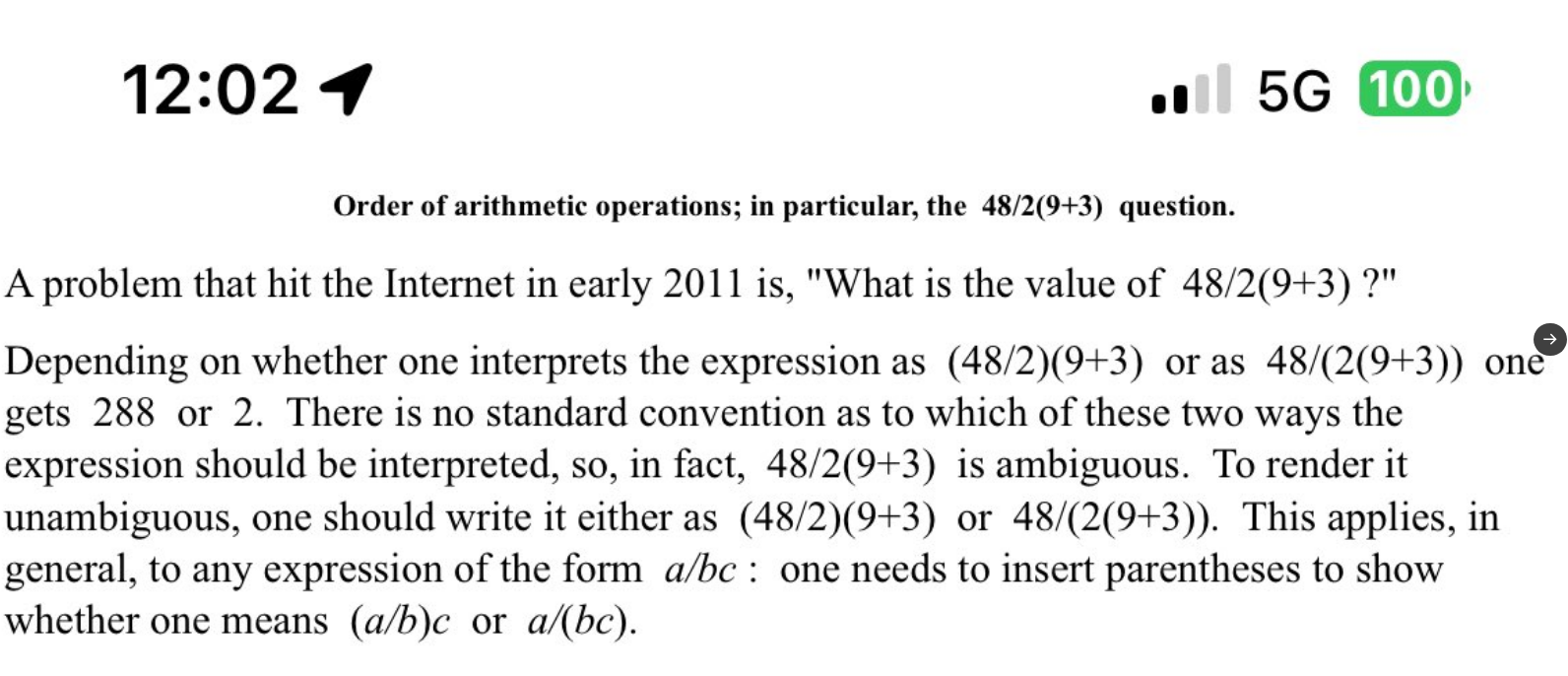
When given a math equation like so;

People are essentially arguing over grammar and using two different mathematical languages.
Below, I will use Bold to show the order in which these are solved following the grammar rules.
BODMAS
8/2(2+2)
8/2(4)
4(4)
16
PEMDAS
8/2(2+2)
8/2(4)
8/8
1
In theory, some people equate to using Multiplication and Division as the same hierarchy and Addition and Subtraction in the same hierarchy as well. So it would then be Parenthesis/Brackets, Order/exponents, Multiplication/Division, and Addition/Subtraction. This is as if you were reading left to right.
And again, ALL three of the above mathematical grammar rules are taught throughout the world. So the one that you subscribe with is dependent on your upbringing and that’s the one you’ll most likely defend and state is true.
AGAIN, people are taught differently from what you’ve been taught. That doesn’t make them wrong. That just makes their education different and their language and interpretation different. Some people were taught PEMDAS to be Multiplication and then Division. Some people were taught Multiplication and Division were of the same hierarchy or order of operations.
Math and Mathematical formulas are sentences and with it comes syntax and sentence structure. Which is taught. Language rules and formalities are a passed down and learned behavior.
To be able to see the different views.
The ambiguity in sentence structures lead to different meanings. The ambiguity in mathematical formulas can lead to different meanings. A few more clarifying words or a few more clarifying brackets can lead to a more precise and determined outcome.
It would be much cleared if the math was;
8/(2(2+2))=1
or
(8/2)(2+2)=16
The more clarifying brackets, leads to a more precise outcome.
Which is a really helpful thing to note if you ever have to write code. You’ll have to apply the code in the same language as your compiler, or the program/software that reads the code. Or else you’ll have bad code that shoots out bugs, because the subjective interpreter is your code reader.

Epilogue
Math is a language. Numbers are like letters. Formulas are the sentences. Grammar exists.
And then if you understand the fundamental basics of the above statement, you can apply that to geometry, trigonometry, sacred geometry, fractals, calculus, frequency, vibrations, and eventually be on the search for some unified theory connecting everything.
Afterall,
Words Mean Things
 Words Mean Things
I was taught PEMDAS, but I’ve come to prefer GEMA: Grouping symbols, Exponents and roots, Multiplication and division, Addition and subtraction. One advantage compared to PEMDAS or BODMAS is clarifying that multiplication doesn’t have to come before division (likewise for addition and subtraction). Another advantage is including absolute value bars (which are neither parentheses nor brackets) under grouping symbols. The main drawback of GEMA is that it isn’t as specific so it might not work as well as a mnemonic device.
LikeLiked by 1 person