
Getting a group of people together to draw pictures and guess what you’re drawing, without directly resorting to words is a form of symbol and sign recognition. Drawing Charades or Pictionary is something that people can play to guess what the object is, to apply a meaning to a drawing, which is how signs and symbols work.
The origin for pictographs of letters that represent things in nature, come from the same developmental skill set you get in drawing charades. You know, like hieroglyphics or ancient Chinese script, each ‘letter’ actually represents a symbol that somewhat looks like the thing they’re describing. In this way, the letter makes sense and is connected to the actual thing it represents.
This is also called logography, and the writing system is known as a logographic script. In such systems, symbols (logograms) represent words or meaningful units (Hanzi or Hieroglyphics) rather than sounds (like in Phoenician or Korean Hangul alphabets). ‘Logo-‘ meaning ‘word’ and ‘graphic’ meaning ‘picture’.
Chinese characters (Hanzi) are a prime example. Many Chinese characters evolved from pictographs (stylized representations of objects) and ideographs (abstract symbols for concepts). Over time, they became more structured and incorporated phonetic components.
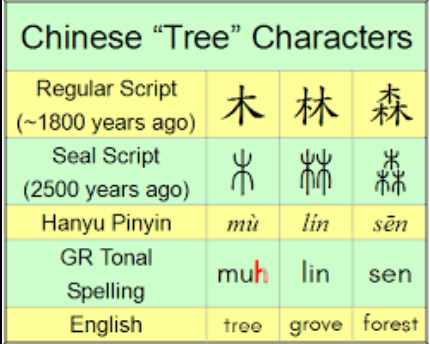
The character for a tree looks like a tree, it’s almost like they were designing a self intuitive system where words mean things. In any case, putting more ‘trees’ together means a forest. We use signs and symbols as a way for us to contain meaning. The signs and symbols become codified into a standard called an ‘alphabet’ and it becomes letters and words.
Another instance relates music with happiness or music with medicine,
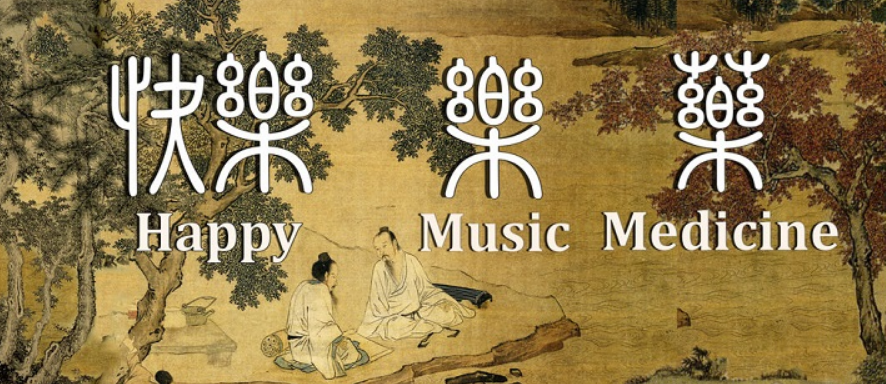
This can make sense if you follow the logic path of cymatics and healing frequencies as well as upbeat or emotional music (not always happy-vibes mind you). So there’s this idea that music can be medicine or that music can make people happy.
I’m not a Hanzi Scholar, but I imagine that character next to the music in ‘happy’ is a symbol for dance;

This could mean that dancing with music makes people happy. Which is a very simplistic and reasonable thing. But Again, I am not a Hanzi scholar, and I don’t know what I’m saying but making a wide conjecture at what could be the case. I guarantee you that the character is a word that means things, I just don’t know what the real meaning is but I’m making a guess.
Hey man, I can butcher any number of old ancient languages (like Hieroglyphics). Point stands- there are languages that use symbols as little drawings to represent real things in reality.
As such, when we play Pictionary, we get a glimpse at how we develop languages throughout time focusing more on the sign and symbol having meaning rather than a Phoenician phoneme of how sounds give meaning rather than the sign itself (like in English or Latin languages).
The Lesson is
Games like Pictionary, or the telephone game, are simple fun games but also relate to a meta-narrative for the structure of reality as well as the dynamic of exchange and interplay between people- notably, communication. Maybe it’s more accurate to say it’s a clue on how we structure our reality. -But reality itself is a construct, but that goes into a debate into philosophy and that’s not the point here.
How we make languages using signs and symbols, we do so in a way that we understand. It’s intuitive, it’s learned behavior, it’s something we do because we want to guess what the other person is trying to say. It’s communication, and it makes a bold theory for how we learned how to communicate.
Let’s imagine for a moment that they ‘9-elevened’ and hit the second Tower of Babel,
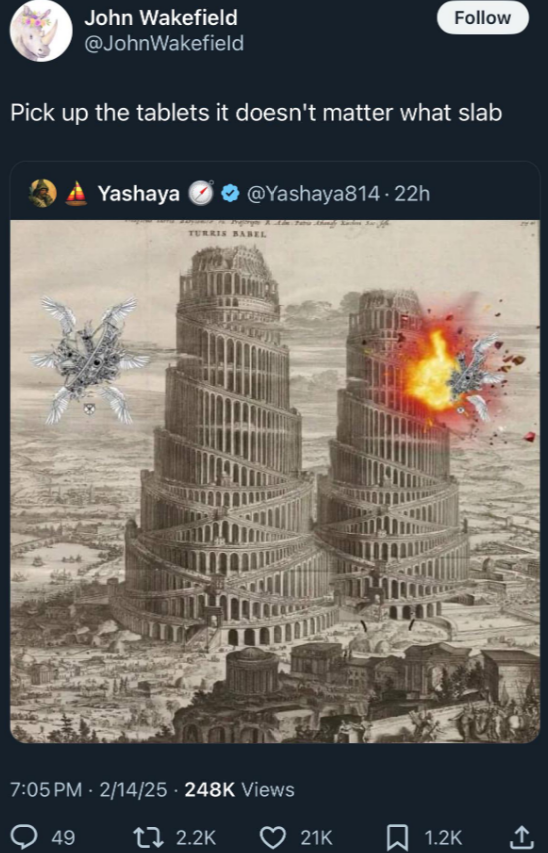
-and you lost all words. If you have to invent your own alphabet with people in your tribe, and invent your own language, then you’d probably do similar things. You might point at something, and grunt or make a drawing, and that becomes a symbol, then you make a list of symbols, all of which means things, to communicate.
The tricky part is to make a list of symbols defined with symbols. I mean, if you look at a dictionary, all words there are defined using words. So if you don’t know any words, then you can’t read a dictionary (duh), and you can’t learn of the words in the dictionary (Sort of like getting an entry level job that requires work experience, a paradox).
Which is another reason why early education and learning reading and symbols is pretty important.
So, in reality, to learn of the words, we have to identify and attribute the signs and symbols to real world things and/or sounds. Which, in a nutshell, is the heart of language and communication.
Also, why are we putting things in nutshells?
Epilogue
All of this is merely to say that communication games reveal a deeper story for humans being humans and ‘evolving’ from no language to having a language. It’s a glimpse or a snap shot for what could be.
Is this what happened? I’m not sure, I’d rather believe aliens popped down and gave us runic symbols and sigils beamed into our skulls, but that’s just arguing intelligent design. Truth is, I don’t know, but the mechanisms that reveal itself in the act of playing these games makes a whole lotta sense.
So signs and symbols relate to the real world reality of sounds and/or things. Signs and symbols turn into words, and of course-
Words Mean Things
 Words Mean Things
Leave a comment