
These are some notes looking at the duality aspect, the Taoist way, of laws in a Western society. Not mentioning any Eastern or Confucius ideas of governance. These are merely musings and are meant to be conversations and contradictory, not truths. Consider it a thought experiment.
There is the idea of law and order and it is maintained by those that uphold it, the knights, esquire, judges, kings, lawyers, sheriffs, cops, etc.
Law can be broadly broken into three sectors that are not mutually exclusive to roles;
- Those who partake or practice the theory of law. Philosophers.
- Those who implement a doctrine, edicts, or codified policy of law. Kings and Politicians.
- And those that uphold or enforce the law. Knights and Cops.
All of this, is a state of order.
The Proximity of Jurisdiction;
Jurisdiction is loosely defined as “the legal authority of a court, government agency, or sovereign power to make decisions and apply the law” and jurisdiction has borders and boundaries and domains of law. For instance, if you break a civil agreement, then the jurisdiction presiding over civil matters come into play, and likewise criminal jurisdictions for criminal infractions, and religious jurisdiction for religious infractions.
Jurisdiction, translates to “(Juris) Legal (Diction) say or writing”. It means the area in which law applies. If you’re in one country or kingdom, you’re under their laws and customs, their legal say, and their jurisdiction.
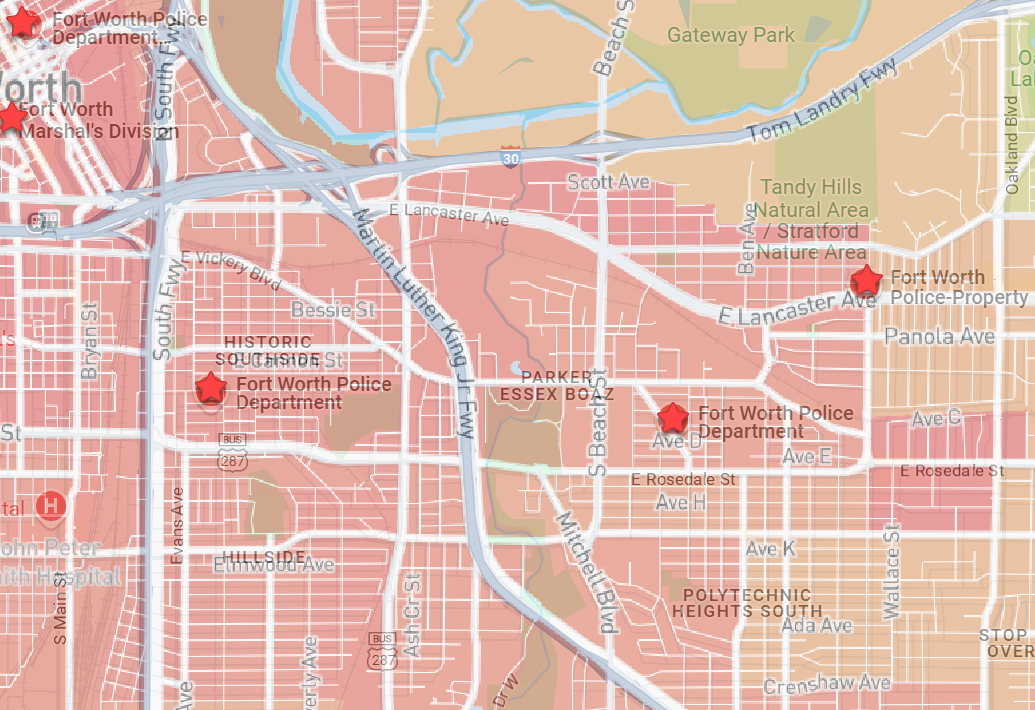
And you’ll find that there is a sort of area or proximity in which the law is upheld. Like a heat map, the closer you are to institutions of law, the more law there is in that area. Much like how people tend to do crime away from a police precinct.
Although in practice, this is not always the case. Here is a crime heat map for overall crime placed over Fort Dallas Texas, noting where the Police precincts are. But in general, the philosophy or thought experiment stands and there’s nuance to the argument for the idea of law and order.
In a household, the head of the house, be it man or woman is the one to decree house rules. Policies on noise, guests, neighbors, and other domestic house affairs. People tend not to deliberately break the house rules in front of the person that set them and that enforces them. If the mother doesn’t enforce the rules, but the father does, children are more likely to keep secrets and break the rules with the mother. This happens if the roles are switched as well.
In towns and villages of feudalism, the law is held by the knights and/or lords. In kingdoms by the king. In empires by the emperor. In nations, by the state or parliament or however they structure themselves.
This is the heart of order and it’s strength is more secure closer to it’s heart. But if it’s strength and law is being put into question, and it’s funding or might is weak, then we may see more lawless or violations occur, even in the heart centers of these places.
If the population density is too high and the economy is unwell, people resort to criminality and that causes more crime even in the heart centers. If the choice is between living by breaking the law, or death, people may (often) choose the life of an outlaw instead of dying.
In theory, towns may be secure with town guards, but the roads between them are less secure. A village near the capitol has more security than a village in the remote areas. The capitol or crowned city will have plenty of guards and military might to enforce the rule of law.
Side note, the advent rise of cars has lead highway banditry to evolve (people posing as police) and be less prevalent (because how would you safely stop a two ton machine going fast?). Meaning most crimes and theft have evolved to target slower moving or stationary targets. Like walking or homes.
The borderlands are viewed as less lawful and sometimes considered lawless. Because the land between two nations might have conflicting jurisdiction, or one nation might have less enforcers or ‘military might’ to protect and secure their borders, or one nation might lack in law all together.
The branded criminals and bandits and highway men are opportunists that infest areas where law is not as readily enforced. They are called “outlaws” because they are operating outside the laws (in action) as well as in lawless areas (in location)
So you’ll see more outlaws in the slums or in remote locations. Yet crime isn’t simply about location away from laws, it’s also about opportunity, so in modern day the areas with high population tend to have higher crime rates.
Political theory
In political doctrine, a king would send a lord to a remote location to establish a town of sorts. To spread the influence of the crown. Typically a higher power is given to these border lords, like a Marquis or Duke. Enough power to keep the neighboring areas in check, the neighboring lords and township, while being able to exact out and judge over higher crimes and punishment that a lesser ranked noble is unable to.
Perhaps because the resources to transport criminals or extradite them for ‘capitol punishment’ is not always available. It may be tough to spare extra Guards and carriages.
As a note; If you break foreign laws on foreign soil, or international laws, you can be a target for extradition to the applicable country to be tried by their courts. To bring outlaws back into law to be tried.
The more authority over the law, the more influence of the law, and thus the lawless area is converted into one of law. It helps spread the influence of the crown.
The number of laws
Overtime, governments and institutions write more laws then they remove. Each law and regulation subsequently making it harder to know and practice and enforce. When there are too many laws to live, people’s way of life becomes outlawed, then the people may choose to become outlaws.
If someone is selling raw milk, and the law makes changes to make raw milk illegal, then you divide the sellers of raw milk. Some will decide to no longer sell raw milk. Some will challenge the authority of law and continue selling raw milk.
In the US history, the prohibition was a controversial piece of legislation, and many sided with alcohol than the government. As the some religious folks would say, “when you invite one sin in you invite the others”, and as jokesters online would say “If I’m going to hell, might as well have a VIP ticket”. If you are branded a criminal for one crime, and the crime leads to a loss of life or imprisonment, then committing more crimes is par for the course.
Similar to the bible verse; James 2:10 “For whoever keeps the whole law and yet stumbles at just one point is guilty of breaking all of it.”
The moment you break one law, you’re a criminal, and if the society doesn’t have a spectrum of reconciliation for the degrees of crime (beyond misdemeanor and felon), then it’s only natural for people to decide to live a life of it instead. If society doesn’t have a method to pardon minor crimes and offenses, that it legislates (similar to a Jury nullification), -like how people smoke marijuana, be put in state prison, and it becomes legal to smoke it in state law, yet they still remain in prison- then what good does it mean to follow the law when it’s already broken?
In another case, if new legislation requires companies to abide by worker’s rights or more pay. These companies might decide to shut down and move to foreign states or countries to operate outside the law. They flee.
Arguably taxes are a law, and thus when people or companies use offshore accounts or tax havens, they are operating in loopholes within the law as well as outside the jurisdiction of the law. Skirting the law in a way.
Thus when a law divides the people, it creates more conflict and sparks of rebellion in the hearts of people. Unjust laws that encroach on freedoms, become tyranny. More unpopular laws divide and push away more people into the lawless or into becoming outlaws.
Imagine, as a thought, that the government loses it’s mind for whatever reason and tries banning the internet or smartphones. How many people would abide by such a law?
What if the government or state decides to confiscate art and burn down books at Fahrenheit-451? What would you do then?
What if the state makes standing still or walking in a weird way a crime? What if breathing was carbon taxed? What if water consumption was regulated and rationed?
The answers to all these questions are made in the moment of having to actually deal with them in reality. Until then, we are brave at a distance, but reality is often much more entangled and intricated into our lives.
Epilogue
This is just a mere look at the power of the pen. The words and writings in policy affect more people than you can think. It’s systemic, it’s codified, it’s words.
If the laws make existence illegal and there is no way to recompense, then people will break the law and fight for their right to exist.
This is well documented in states and nations that put for unpopular laws or ethnic cleansing. People tend to fight or flee against tyrannical and oppressive regimes.
So consider that if you’re a policy maker. To not divide culture or people to the point of being beyond reconciliation. Because that’s how you get rebels and insurrectionists or worse.
Overall, the law grows more than it sheds. So we as a human society, have to collectively work to ensure we don’t have laws that make it suffocating to live. If you look at it another way, these laws are a form of deeply encoded collective subconscious of our society, the collective shadow, and we must re-evaluate them as we grow, or we will end up narrowing our future potentialities and collapse.
If you can’t open up your own taco truck stand or sell burgers on the side of the road because the initial bar for entry is beyond accessible. Are you free?
If the law makes your life or existence illegal, what would you do? Would you fight, run, or concede?
Law relates to Lex, and Lex or lexis means the Word- as such;
Word Mean Things
 Words Mean Things
Leave a comment