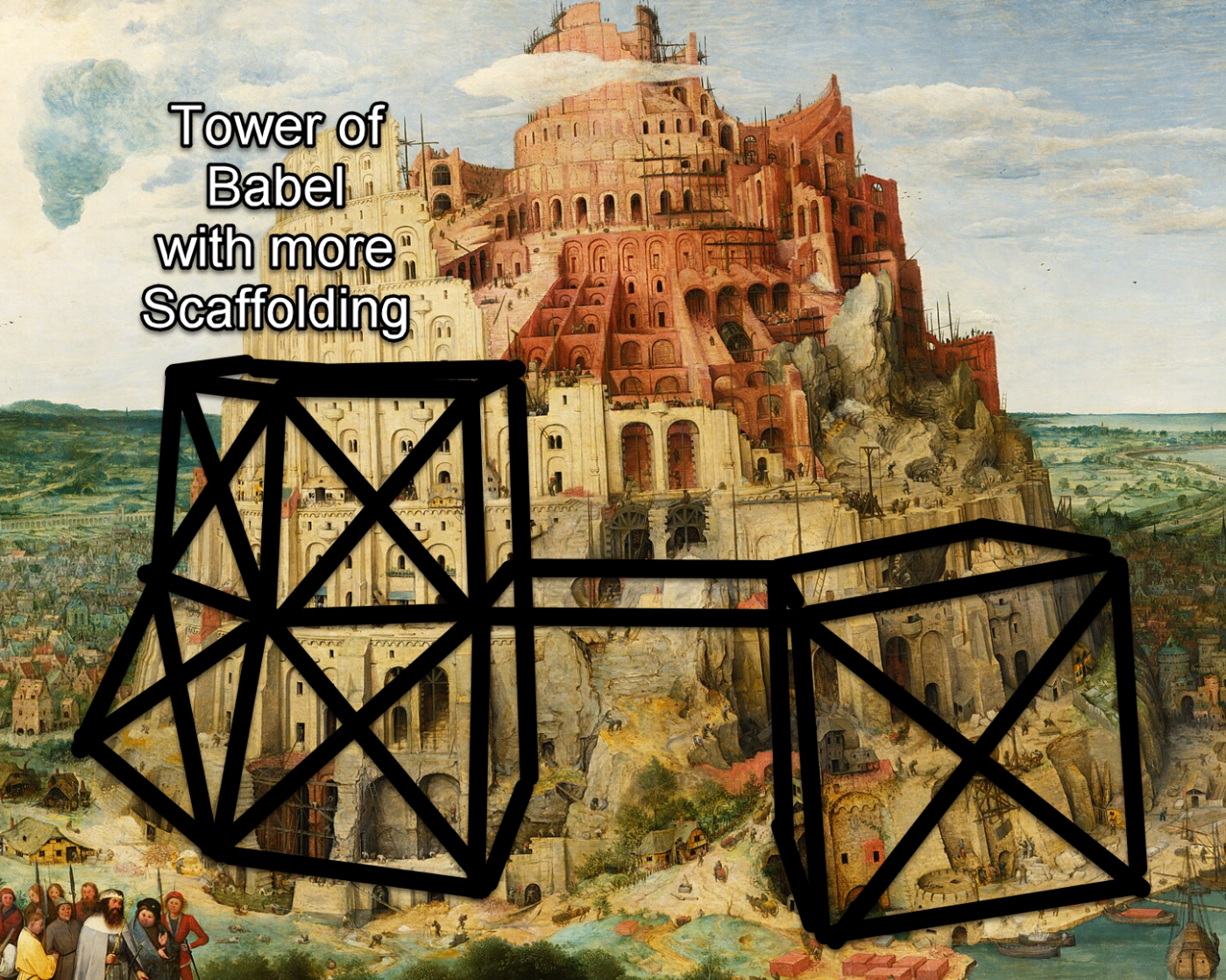
The Following is an excerpt from my previous writing about The Death of an Author x Poe’s Law. I wanted to roll into this excerpt and expand on it, to discuss the idea of framing and reframes, with how we can shape our perspectives and change the ‘lens’ or ‘looking glass’ that we perceive things in/through.
Framing in Art
There is a focus of intent in post-modern and modernist art.
- Some artists prefer the art to be captionless and titleless, allowing the work to speak for themselves.
- Some artists make a shoddy piece of work and put or pour the entirety of their art into the caption.
- Some artists pour art into neither.
- And the old school traditional artists would pour their art into both-
- -or just the art itself.
The idea of Titles and captions could frame the ‘intent’ of an art piece. The framing of a piece as well as it’s juxtaposition to other pieces can give it a different angle. How a piece sits and frames against other pieces.
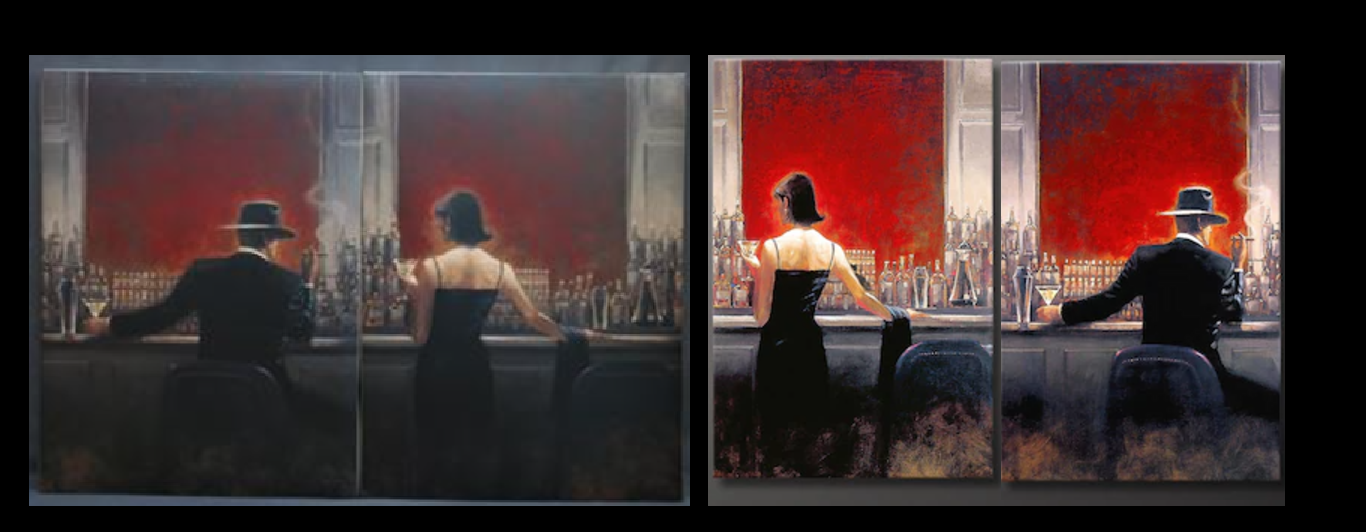
Are they together, apart, lovers, strangers, or something else?
For instance, if an art piece was small and buried behind many art pieces, with the art piece (of, say an old dog at an adoption center) being called something like “buried in the back and waiting to be noticed”, it would be framed as a way of self discovery for the viewer when they find and take notice of such a piece. The environment and the other art pieces would ‘frame’ the existence of the painting.
(feel free to make that art piece above come alive)
If a Title of a song sets the mood or feeling, then these words have a sort of introductory or framing effect. Even the lyrics within a song can give it enhanced meaning. Some people don’t know or are unaware of the lyrics of a song on their first few listens, and when they understand the song, it’ll mean something completely different after having been understood.
In this sense, when does the art start and end, does it include the framing within the art?
I discuss a lot about the framing, because it shows a sort of mirror reflection of the intention of the author. A Frame can be a simple frame, or it can be a signature itself and reveal something greater. -And that’s just one aspect of the work.
We often times try to find the string of words that paint the story behind a work or story. The Caption or even the ‘scoop’ behind the scenes into developing a movie or song. The meaning behind a story, and meaning can be viewed as intent (as well as effect or result or means). Intent is one facet of meaning, typically meaning the intention of one for doing something. That is meaning itself. But do the results matter more or is it means that make the method? Maybe, maybe both, maybe not.
That was the end of the excerpt,
In terms of words
Frames and Framing techniques are a matter of perspective, specifically with words, it allows people to look at something in a particular way or from a specific angle.
Here is an instance of framing without words specifically;
If I were to carry a bucket and make it look heavy while I shake my arms and stumble asking you to pick it up, you might assume that the bucket is heavy. When in fact it could be very light, and you might overcompensate to pick it up and end up throwing the bucket upwards or staggering behind you because of how light it is. It’s a prank as well as a subtle form of manipulation, my struggles frames the bucket to be heavy when in actuality it’s not.

Is it heavy? Can you tell?
What did you think prior to me asking?
To make something big seem small, and to make something small seem big is a form of deception, which is an art, as well as a form of framing. To Frame something in a manner that people perceive it a certain way, like a sort of mask or a coat.
If I were to frame something or introduce something, it would give you a sort of description and way to think about something.
If I say “Have some of this chocolate, it’s not that good”. You might think it’s bad chocolate or think I’m joking, or even be suspicious or offended that I offered ‘not good’ chocolate. Perhaps I’m being realistic and allowing you to try mediocre chocolate without lying to you.
“Have you watched this great show?” – In this case, I’m not inviting but projecting onto you a show, which can seem aggressive especially if you don’t respect me or trust me. My use of the word great, could make you think that it’s worth checking out or maybe it might make you skeptical. Perhaps you might even think I’m bragging about my own tastes or subjective flavor for shows.
“be safe!” – This is a common phrase people tend to say to others before they try something or go somewhere. It frames the something or journey as having inherent danger and you’re reminding them of the possibility of danger while focusing on the safety aspect. It can also make people annoyed that you’d think they’re too incompetent to be safe or do things safely. It can also come off as an empty platitude. You can play with this by saying “be dangerous”, and that frames the future of the conversations to be similar.
Obviously with the above, there’s many different ways to take things when said. A picture frame has four sides, so with your frames in words, you can support a specific perspective by having a better or stronger frame. Here are some more advanced frames:
“I’m just an amateur photographer, I have a small portfolio if you want to check it out on my instagram”. Here I am framing that I am either humble or not that great starting out. Someone can see it as an invitation to inspect me, with social proof from Instagram. Additionally this doesn’t instill confidence or trust in someone, especially if they’re a prospective client. People typically either want to hire experts who can get it right, or someone new and inexperienced to get things cheap.
“Jack is a bad guy, he once stole candy from a baby and went viral online for it”. Here, I’m providing context and history to the association that Jack is a bad guy. Further reinforcing my point with evidence. I am also offering validity to you to self validate that Jack stole candy, if you’re interested in watching it online. Alternatively, I could have lied about all of the above, and you might be too lazy or too occupied with other things to even see the online video that may or maynot exist and thus you trust my words for face value.

‘Good News’ or ‘Bad News’?
As with the instance of Jack above, pay attention to how the media frames both sides of political issues, whether it be for domestic affairs like Presidents and senators, or how the global stage of politics is ran. I’m asking this of you, because you’ll see how the bias is implied and interwoven in the frames. People will paint their side in a brighter light and paint the other in a negative light, enforcing a tribalism appeal.
In terms of Framework;
-Arguably an entire book can be developed using frames, thus creating a scaffolding called a ‘framework’ for understanding an issue.
If I were to read the Communist Manifesto, I would see the perspective and framework that Karl Marx had described in a viewpoint from a proletariat wanting a revolution against the ‘elites’ of the bourgeois.
In another case, in order to understand the current thinking of food science, you’d have to frame that atoms exist and that atoms are bonded and turn into chemicals and that these chemicals react differently with other chemicals and also in our body and that causes both good and bad things to happen. Which affects our health and mindset and even genetic makeup. This framework is basically a bunch of theories or stories built upon each other to set up the stage for you to see things the way that someone else would. This happens in politics, in Physics, in Religion, in every context imaginable.
There’s framework to say something is good and another to say something is bad. These are the various perspectives you get when looking through a different looking glass or frame.
Sometimes a frame can reveal the truth,
sometimes a frame can disenchant the lies,
and sometimes the frames can paint the lies as truth,
or make the truth a lie.
(This is important)
When we build a scaffolding of framework of thoughts and beliefs that we think are true, what we’ve done is created a foundation for our reality. The matrix of our mind is a construct of beliefs that can help or hurt us depending on the situation. So your version of reality is based on the various frameworks that you hold and your ability to be able to view reality through all or some of them.
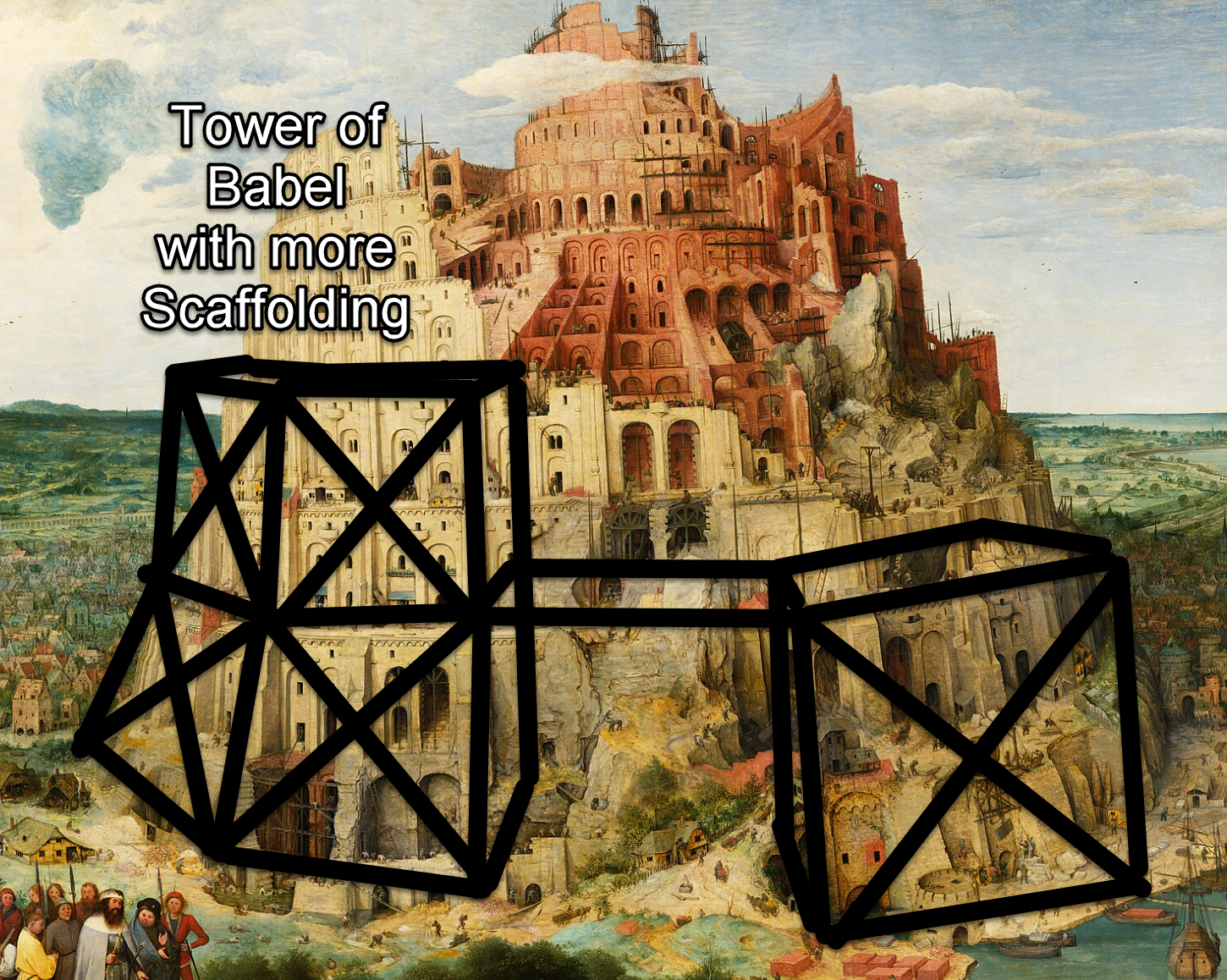
This image sorts of relates to the idea of a ‘mind palace’ or ‘mind garden’ but more in the form of reality and not just a thought or mental projection. It’s the construct of our base reality through the lens of language and words, words that act as building blocks or symbology deep-rooted in our psyche personal and collective psyche- that create the foundational reality (or hyperreality if you guys like Derridean lines). (I also think it’s a silly looking image, and it’s also symbolic too)
The labels and beliefs you have of yourself, whether you think you’re smart or dumb or good or evil, are all a part of a narrative that creates your framework called self identity. This can limit you from doing one thing like saying “you’re bad at music so you don’t try to make music”. Which can be a helpful limiting belief, but if music is what you personally need to live and express the soul, then it can crush your soul by not allowing you to express yourself.
So, consider the frames in which you’ve constructed for yourself, and try to catch where things might be better for you if you ‘framed’ things differently in your mind. To frame things differently, it’s typically called a ‘reframe’ and I have some techniques I can share;
Some Framing Techniques
These are techniques that incorporate my study in logotherapy as well as Neuro-linguistics processing that can give people some clues as to how they might re-evaluate their situations or empower themselves to tackle issues.
Re-frames
Someone might complain about a myriad of things, and I invite you to explore a complaint as an opportunity. That a problem is both something that can be solved and also worth solving.
Perhaps even the problem itself is a solution. For instance, if two people are fighting for something that each other wants, a trade would turn their problems into a win-win solution. Sometimes it is that simple, and other times ‘humans’ make it complicated.
If someone is the head of the household complaining about doing the dishes, you can remind them that they had food to eat and that each plate is a mark of success for a mouth fed and that is a reminder that they’re doing enough now in the moment, to be able to take the time and recognize and be grateful for what they have.
Essentially, framing negative experiences that you have into positive and even joyful ones.
Positive thinking and positive framing go a long way.
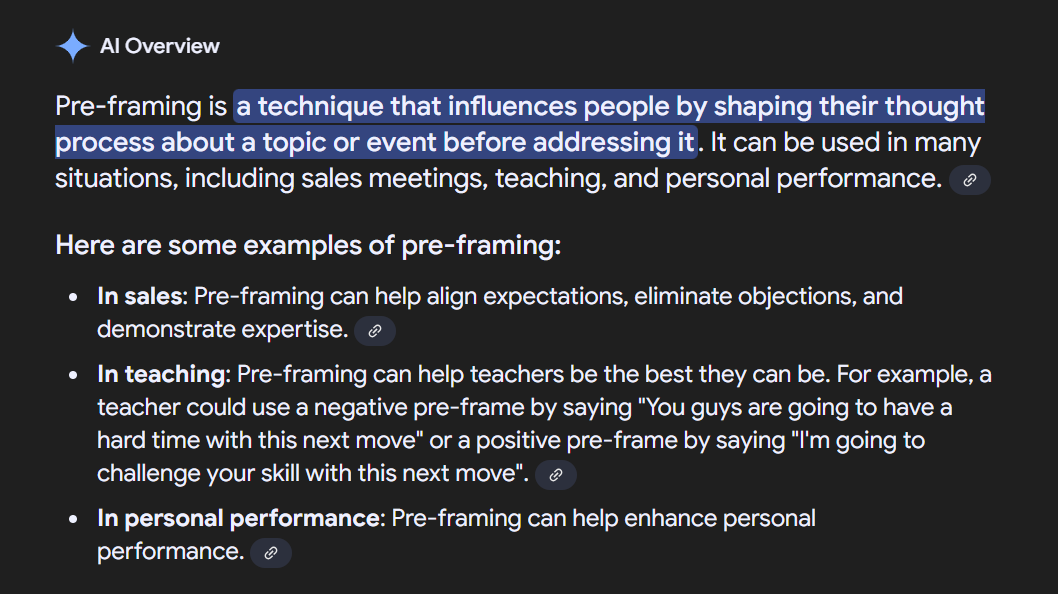
Additionally, I’d like to add there is a ‘pre-frame’ which is a re-telling of a re-frame, reminding and pointing back to how things are or structured. This is not the focus of the article but it is a valid tactic to cite that exists;
The “I Get To Frame”,

A lot of the motivation culture pushes out the idea of “we get to” rather than “we have to”, in order to say that each challenge or work is an opportunity to grow and survive.
I have to go to work vs. I get to go to work
I have to go grab the kids from daycare vs. I get to pick up my beautiful kids from a good daycare
We can use a few words to reframe what we thought negative into the positive. But of course, try not overdoing it, or else you might frame something really harmful as something positive. For instance, if someone is
There is an ‘Act-as-if Frame’,
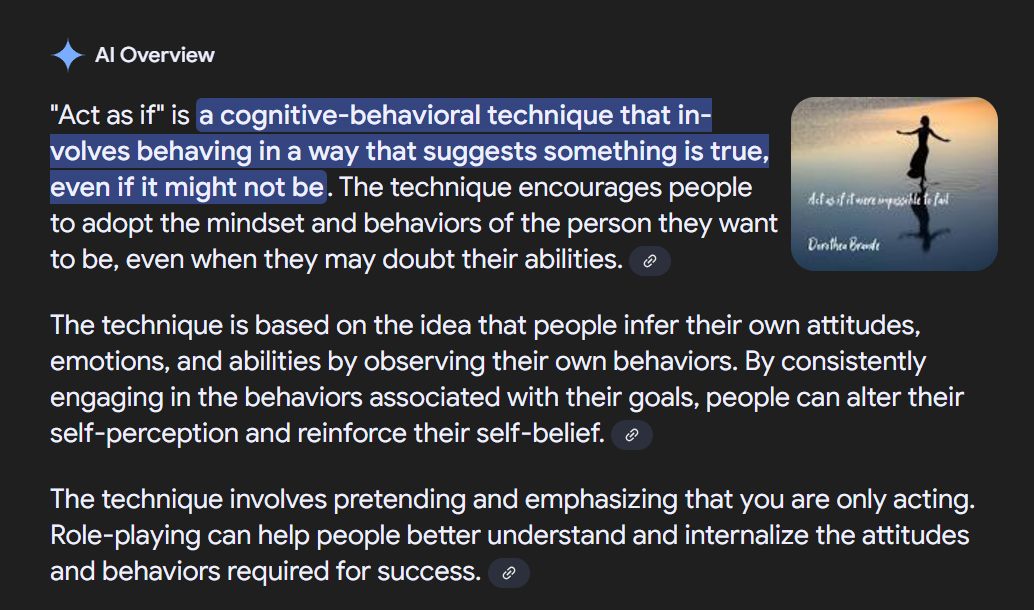
This where you frame something is true and have people role play or personify the persona to act it in that way. You frame the initial as a sort of presupposition or taken to be true assumption or presumption. As fact a priori. Here are some exampled:
If someone is scared to do something,
“Act as if you weren’t scared. What would you do?”
If someone is struggling with going out,
“Act as if you’re a socialite, or a pirate, have fun with it.”
If you want someone to pretend to try and be smart,
“Imagine if you were Sherlock Holmes, what would he look for and do? Act as if you were”
If you want someone to have more confidence in doing ______
“Act as if you were Secret agent pretending to be your old self, you have a lot of support but can’t receive physical or financial support due to mission constraints. We do have a new mission, if you so choose to accept, is to do _______”
It sort of suspends disbelief in a bit and invites people to try an act. To allow people to believe or become a person that they want to be. This is a sort of low level form of method acting, so it’s not as dangerous. People can still have their egos bruised but they can also learn to explore and stretch their ‘frame’ of their current identity or persona allowing new insights and thoughts into their being.
It’s sort of like a game where people can freely improv to see if they’re aligned to that method or style of being. Acting as an actor in the world’s stage, a play. It’s a sort a BS’ing your way into feeling more comfortable with a BS, and integrate the parts that are true to your original self, to honor your self.
“Whether you think you can or think you can’t, you’re right” – Henry Ford
This is ultimately about swapping some basic beliefs and allowing someone to manifest an alter ego or persona to help guide them into being more multi-dimensional than a timid and afraid. This especially works well when people like the characters and want to be them. For instance, I did this on myself to be more like Sherlock Holmes and I swear my perception of reality shifted to that of a more intellectual, albeit, sometimes a pseudo intellectual. haha.
Duality of opinions
This is a frame in which you wear the shoes of the other person. You might see an event or something happening and you have your own framework of understanding for why it is happening and what to do. In this case, try to be impartial and entertain the other person’s perspective.
Why would they do the things they do? What drew them to the conclusion to think it’s a natural one? Did they not have the tools or ideas to be able to perform in a specific way?
Word of warning, some people have such strong frames that you might reject them outright preventing your own understanding (which may be for your own safety), or they might have such strong frames that you see their world. And when you see their world down the rabbit hole, you might not be able to crawl back. So, don’t try to hard to understand things or people that are far from your own understanding, it might make you into a Heath Ledger type of Joker and the method acting of wearing the mask might start wearing you.
If you try hard to see a perspective that is radically different from your own, you might be building a bridge too far and that bridge can collapse. You might get stuck on one side or the other. You might even have a schism and fractionate portions of your own psyche.
I don’t know if I should even write any of this, but I’m sure if you find yourself on this website, you’ll likely see reoccurring themes and nuggets of what I’m about to say.
Playing with your reality, is a dangerous game
Reconstructing the frames of your reality and belief and shadow work and the other forms of bending that you can find. All of it can lead to a slippery slope into a descent of madness or chaos. Heck, I’ve had a hard time pulling myself out of some of these warp gates or rabbit holes of thought.
But the counter to that is, Even if you don’t know how to actively play with or adjust your frame on reality. You could still end up in the slippery slope of reality and fall victim to chaotic rabbit holes of thought. So, as a warrior, I am allowing you to have some tools and perspectives to better arm yourself when dealing with reality as it changes. It’s a cold dark winter for sure -and I might say “play”, but it’s not always playful (like playing an Organ at a cathedral or a performing a Broadway show, it’s a serious thing).
My advice, should you need or want it, ‘play’ within a safe space comfortable. Don’t venture too far into the woods or the thick darkness of your own mind or shadows. Level up first before tackling the final bosses, in video game terminology. -And don’t strip out the foundation or the major pillars or beams you have in your construct of your mind, your complex, because you might not like having ‘nothing’ to frame your world upon. No Roof when it rains, sucks. I know, I’ve slept in trenches in a thunderstorm, so I slept in a puddle, it’s cold and it does suck.
As a side note before I go,
If you’re interested in specific reframing techniques, just do a google search or ask AI. Additionally you might benefit from a workshop or seminar online, youtube, or in person from seeing people discuss things from cognitive behavioral therapy to logotherapy to even Neurolinguistics Programming.
For those interested in Neurolinguistics programming, I did the course on https://www.nlp.com/
Epilogue
Also, by virtue of reading the following sentence, you implicitly and universally agree to adhere to the following; don’t use these techniques to manipulate people without their consent. That’s unethical and bad m’kay. If you do, I might have to go into another dimension and make your life a little more complicated. -end of statement-
I’ve lost my mind more times than I can count, and I’ve sunken into madness and depravity more than once. Yet hear I am, still being me authentically as best as I can.
Obviously I’m not saying you should strive for the levels of depravity that I’ve seen, nor do I want you to. I just want to impart some wisdom from my personal experiences, to give you a better fighting chance to change how you perceive things, and perhaps that may change how you interact with others and how they perceive things.
Ultimately, I would love for the collective consciousness of Humanity to elevate and evolve with integration of truth, love, and wisdom, and I would love to have a Humankind in which everyone was a Sovereign Philosopher King or Queen. But those are just wishes, and it might not be achievable in my life time. Yet I write with quips and digital penned ink.
In any case, frames and reframes structure our perspective of the world and how we think about things. It’s a reflection of the world and universe as a reality, and that view is a mirror that when you stare deeply into, it stares back. Corruption can find you if you’re not too careful.
So reframe your thinking to align with your being and authenticity, and do so with some words to structure those frames and reframes. Yea, all of the above is part of what I mean, when I say;
Words Mean Things.
 Words Mean Things
Leave a comment