
To continue on with the post “If we didn’t have a name for it, A Word, does it exist?“
Does something exist before we observe it or does it exist after we observe it?
In terms of object permanence, babies aren’t fully developed in the brain thus they only see what they believe and believe with only what they see. The game ‘peek-a-boo’ where an adult would cover their face and then reveal it again is a sort of magic show for babies, one minute you’re in their world, the next you disappear. – In computer gaming terms, we are rendering an object infront of the player and dematerializing it. If you subscribe to simulation theory (or a Truman Show Solipsism), then it’s similarly the same thing.
Culturally, we’re designed to live by some metaphors, one of which is “seeing is believing”. Having been there and witnessing something allows someone to be a primary source evidence to historical accounts and allows for a scoop of the situation.
Often times we may doubt people and hit them with that “yea, I’ll believe it when I see it”, as a sort of doubt to anyone’s attempts or declarations or statements. Such statements reinforce the idea of seeing or observation to reinforce the reality of someone else’s fantasy. Delusion or not.
If we go further, does labeling something make things exist or do the things exist before labeling that something?
If you found the color blue, does it exist if you didn’t know it was blue? If you thought that blue was all a shade of grey.
Maybe you don’t know the color pink, so do you call it light red? Is that color still pink?
What of the colors that we don’t perceive? A tetrachromat surely can name new colors that trichromats can’t see. Similarly colorblind people are unaware of colors that the average person can see. This is all while stating that the human corona can only perceive a small band of electromagnetic wavelength as color, that we dubbed ‘visible light’. Yet there are a lot lot more wavelengths out there.
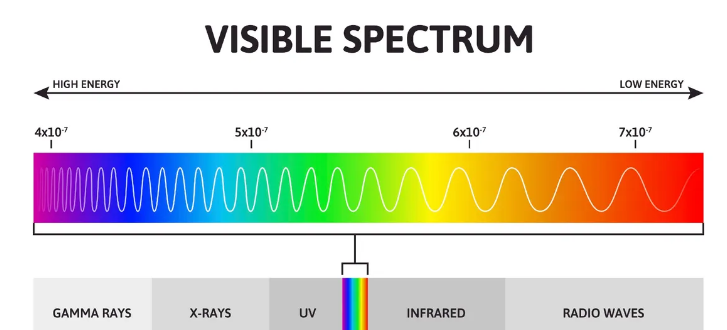
on average, humans can only see something
between ~300 to 800 nano meters,
Yet there are Gamma rays at 10^-15 metres
and Radio waves at ~300 meters
Thus, the small slice of electromagnetic waves that we can visibly see with our eyes is so small, that it makes us kind of silly for labeling other humans with colorblindness.
Does the idea of labels allow an observer to create a construct to adhere to? Does a label shift the perspective to make the construct exist? Creating a sort of bias, because the label is different, then so it must be different.
If I say that I have a friend named Steve and I go into a long rant about his wife and kids and his housing situation with his job. Does that make him more real that you perceived him through my story? Does that mean you observed him? Or does that make him a mere metaphor that doesn’t necessarily exist? Perhaps both? Have I just shared only a slice of my own small perception of him for you to perceive that small slice? Is your perception of Steve through second hand accounts more or less of my own?
In terms of diagnosing ourselves and labeling ourselves;
If we call ourselves introverted or extroverted, does the idea hold true that we define ourselves by these labels and act accordingly? Did that occur before Carl Jung founded introversion and extroversion? Or does the behavior of extroversion and introversion exist without the labels? Does the label push the self image towards one direction or another? As we start identifying as one or another, giving way to fit to mold into either an introvert or an extrovert. Even though its a spectrum and circumstantial.
As you may see, when we become aware of something, we become aware of what it is and what it is not. We become aware of the Dao of duality and then we are the observer that decides whether or not we become that or the opposite. Perhaps we try to ride the fine line of grey inbetween.
How about a title? Do people who label themselves as a Carpenter see themselves differently than if they labeled themselves an Executive? What if they were a Carpenter Executive that ran their own Carpentry business? Did the person, behavior, and their work that they do change or are in anyway influenced by this label? At what point are you given a title or job role and feel as though you’ve made it or upgraded?
Why do Americans and Western Society always ask ‘what do you do for a living?’ Are we trying to categorize people by their title and give them a worth? Are Human beings more of Human Doers than beings? Or is the idea of ‘being’ too existential and big to comprehend, thus we use smaller pieces of our existence like our job roles to help eachother navigate in our relations in life?
What of a name? If a person associates their identity with their childhood. Wouldn’t giving a new name give them a new identity. A new opportunity to redefine themselves. Isn’t that why people partake extreme or abnormal rituals to receive a name? A trauma to associate an extreme stimulus and anchor it to the name?
Many Warrior traditions and Shamanic Traditions or even rites of passages in fraternities and on-the-job training in corporations give a sort of accreditation or degree, with it comes a new name or title. But with a new name or title, do we change? Or does the world perceive us differently? Does that make us change? Or do we decide to see ourselves differently? Is it both?
People who are named unconventionally with ‘weird’ names or names that are spelled differently may be mocked or ridiculed or may even have hard time getting proper paper work to match their name on official documents. How much of a label does the name affect us? If a man with a feminine name introduces themself, would they be observed differently? Is changing your name and label a way to also change the observation of a person differently?
Often times people ‘make a name for themselves’ and forge their own path and receive a new moniker in line with their works or aspirations. Does that make them different from who they were? Do they observe themselves differently? Do they observe themself differently with a new name?
Did the name and label, after learning of it, change who we are or who they are? Does it change the perception of them or ourselves?
What then of a King and a Slave? What then of a name that borrows from different ancestral roots than you? How do these names and titles affect us? Our Existential observation of ourselves.
As a bonus, people who take personality tests or subscribe to astrology learn about some model or label that applies to them. This creates a division and a distinction, a sort of standard to which we can compare ourselves. Is the label more true or not? Does that mean that we unknowingly followed these archetypes from personality tests or astrology? Or is it the act of observation a sort of self-fulfilling prophecy, where we observe ourselves with the label and are destined or doomed to fill it?
Epilogue;
I’m just asking thought provoking questions. There is great power in a label, and it can forge all sorts of paths, whether they be our title, our associations with groups, or our names themselves.
A Label is a word that defines what is and isn’t. It then falls under a set of hierarchies based on whatever we’re measuring (like familiarity or uniqueness or status). A word merely boxes the abstract meaning into a defined box. That’s what words do.
So, what labels do you have on you? What labels are bringing you closer to your desires? What labels are holding you back? What labels do you give power to? What labels do you react strongly towards or against?
Afterall, Labels are just words and
Words Mean Things
 Words Mean Things
Leave a comment